 ebba.ossiannilsson
JRC Framework for educators´ digital skills
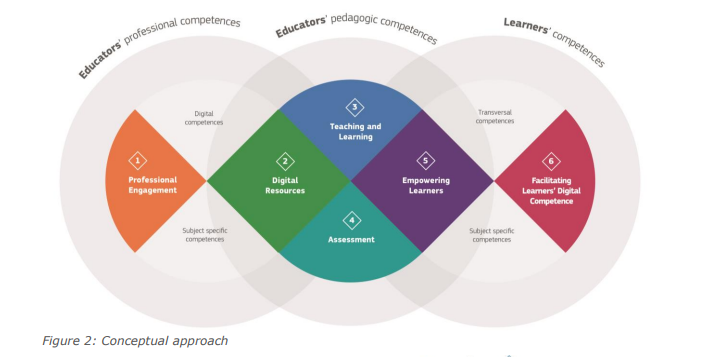
The EU Commission has launched a framework for educators' digital skills. The framework is intended to spread in all areas of education in Europe, from K-12 to higher education. The framework is based on a previous framework for "Digital Citizens".
The DigCompEdu framework is directed towards educators at all levels of education, from early childhood to higher and adult education, including general and vocational training, special needs education, and non-formal learning contexts. The development of the framework is based on the analysis, mapping and clustering of the elements constituent of educators’ digital competence, as these are detailed in existing national and international frameworks, self-assessment tools and certification schemes. The reference model thus generated will be subjected to extensive stakeholder consultations and complemented by proficiency levels. As final product a self-assessment tool, which allows educators to assess their own level of digital competence, will be developed.
The framework aims to provide a general reference frame for developers of Digital Competence models, i.e. Member States, regional governments, national and regional agencies, educational organisations themselves, and public or private professional
DigComp 2.0 identifies the key components of digital competence in 5 areas which can be summarised as below:
1) Information and data literacy: To articulate information needs, to locate and retrieve digital data, information and content. To judge the relevance of the source and its content. To store, manage, and organise digital data, information and content.
2) Communication and collaboration: To interact, communicate and collaborate through digital technologies while being aware of cultural and generational diversity. To participate in society through public and private digital services and participatory citizenship. To manage one’s digital identity and reputation.
3) Digital content creation: To create and edit digital content To improve and integrate information and content into an existing body of knowledge while understanding how copyright and licences are to be applied. To know how to give understandable instructions for a computer system.
4) Safety: To protect devices, content, personal data and privacy in digital environments. To protect physical and psychological health, and to be aware of digital technologies for social well-being and social inclusion. To be aware of the environmental impact of digital technologies and their use.
5) Problem solving: To identify needs and problems, and to resolve conceptual problems and problem situations in digital environments. To use digital tools to innovate processes and products. To keep up-to-date with the digital evolution.
The DigCompEdu study builds on previous work carried out to define citizens' Digital Competence in general, and Digitally Competent Education Oragnisations (DigCompOrg). It contributes to the Commission's recently endorsed Skills Agenda for Europe and to the Europe 2020 flagship initiative Agenda for New Skills for New Jobs.
Share this
Blog archive
-
2026(14 articles)
- September 2026 (1 article)
- August 2026 (1 article)
- July 2026 (4 articles)
- June 2026 (3 articles)
- March 2026 (1 article)
- February 2026 (1 article)
- January 2026 (3 articles)
-
2025(4 articles)
- October 2025 (2 articles)
- September 2025 (1 article)
- January 2025 (1 article)
-
2024(5 articles)
- December 2024 (1 article)
- September 2024 (2 articles)
- June 2024 (1 article)
- February 2024 (1 article)
-
2023(12 articles)
- November 2023 (1 article)
- October 2023 (2 articles)
- May 2023 (1 article)
- April 2023 (4 articles)
- March 2023 (4 articles)
-
2022(18 articles)
- November 2022 (7 articles)
- September 2022 (1 article)
- August 2022 (1 article)
- July 2022 (2 articles)
- April 2022 (1 article)
- March 2022 (2 articles)
- February 2022 (3 articles)
- January 2022 (1 article)
-
2021(14 articles)
- December 2021 (10 articles)
- May 2021 (3 articles)
- February 2021 (1 article)
-
2020(25 articles)
- December 2020 (4 articles)
- July 2020 (4 articles)
- June 2020 (3 articles)
- May 2020 (4 articles)
- April 2020 (2 articles)
- March 2020 (4 articles)
- February 2020 (1 article)
- January 2020 (3 articles)
-
2019(29 articles)
- November 2019 (2 articles)
- October 2019 (1 article)
- July 2019 (2 articles)
- June 2019 (2 articles)
- April 2019 (2 articles)
- March 2019 (2 articles)
- February 2019 (3 articles)
- January 2019 (15 articles)
-
2018(29 articles)
- December 2018 (4 articles)
- November 2018 (6 articles)
- October 2018 (3 articles)
- June 2018 (3 articles)
- May 2018 (1 article)
- April 2018 (2 articles)
- March 2018 (3 articles)
- February 2018 (4 articles)
- January 2018 (3 articles)
-
2017(12 articles)
- December 2017 (4 articles)
- November 2017 (7 articles)
- October 2017 (1 article)