leadership

BILTEVT2025

Bild 1I had the great pleasure and honor to contribute and to speak at BILTEVT'2025 "UNIVERSAL DESIGN IN INFORMATION TECHNOLOGIES" -INTERNATIONAL BARRIER-FREE INFORMATION 2025 CONGRESS BILTEVT'2025 " October 15-17, 2025, Manisa. The Opening Ceremony and all sessions of the congress were held in the Akide Sultan Hall, which was broadcast live on the Barrier-Free Informatics YouTube Channel.  Sign language interpretation was available during the sessions.
4d29be6b 4801 44ef 9d3a b4bb820ae6f60528ddbc 2495 4a89 9ed5 76c9f43396ca

My session was on Leadership and learning in the age of AI: Towards inclusive, ethical, and human-centered transformation, as program below. The presentation can be downloaded here at Slideshare Ossiannilsson.

My very first message was that education and leadership must evolve for a world shaped by AI, uncertainty, and complexity. 

I argued further that Leadership through uncertainty in higher education institutions involves navigating rapid change, disruption, and ambiguity with resilience, adaptability, and ethical responsibility. It requires balancing institutional stability and innovation while fostering a culture that supports care, curiosity, and challenge.  Such leadership empowers staff and students to view uncertainty not as a threat but as an opportunity for growth, transformation, and inclusion. It emphasizes transparent communication, trust-building, and courageous decision-making even in the absence of complete clarity. By aligning values with a long-term vision, leaders in HEIs can ensure sustainability, equity, and scalability, positioning their institutions to thrive in complex and unpredictable educational environments. I also argued that a Culture of Care, a Culture of Curiosity, and a Culture of Challenge are leading to Inclusive, Scalable, and Sustainable education for the individuals and the planet, so-called planetism. Furthermore, AI must serve humanity — not the reverse. “AI for Good” means AI that is open, inclusive, and transparent, and should be guided by the UNESCO and the EU frameworks, which have humans/people at the centre.  

As my topic was Leadership and learning in the age of AI, I also focused on the ecosystem of lifelong learning in this era, emphasizing that learning is lifelong, lifewide, and lifedeep. There is a need for collaboration between academia, policy, and civil society, and flexible pathways, micro-credentials, and recognition of informal learning

 I also took the opportunity to introduce the newly started NordPlus project, A Lifetime of Learning: The Mapping Methods of Competence Development in the Workplace NPAD-Y2025-10300, funded by the Nordic Council of Ministers. The project brings together partners from Denmark, Finland, Iceland, Norway, and Sweden to document learning methods developed and implemented in the workplace. We will focus on the healthcare and technology sectors. These sectors are broad to allow for the selection of target groups during the initial stages of the project. Coordinator is the Flexible Education Norway #letstalkaboutnordplus

Finally, I called for actions and that Education and leadership must evolve for a world shaped by AI, uncertainty, and complexity. I concluded with three calls to action:
• Leadership in the age of AI is not about technology — it is about humanity.
• Lead with vision, care, and courage.
• Shape education for inclusion, sustainability, and ethical transformation.

ICDE Leadership Summit 2024

The ICDE Leadership Summit2024 was hosted by ICDE Institutional Member, Globethics, at Campus Biotech in Geneva, Switzerland, and took place from June 5-7, 2024 in Geneva, Switzerland. The conference focused on the theme: “Ethical Leadership in the Age of AI: Rethinking the Future of Education“. The conference explored the current challenges and opportunities facing today’s education leaders and innovators in the globally connected digital age. With delegates from around the world, the summit provided a vibrant, inclusive space for unique networking and development opportunities. The conference aimed to learn more about how AI is shaping the future of education. Leading stakeholders, keynotes on global education, and panel discussions explored AI in the context of teaching and learning. Institutional best practices, the forum for partnerships and joint initiatives, and interactive spaces where participants could showcase their projects and share innovative ideas on selected topics helped the conference develop policy recommendations for education authorities on AI and higher education. The conference gathered some 150 delegates from around 80 countries. 

The Elephant in the room

The most important insights I took away from the summit concern the elephant in the room or the attacking elephant.
The natural human response to an encounter with an elephant is fight, flight, or freeze; what should we do? Another insight was the discussion on ontological and epistemological development for open education and ethical leadership in the era of AI. See also my LinkedIn post from after the conference beginning of June 2024 

I was involved in several events myself

  • ICDE Board meeting Strategy plan 2025-2028
  • Panel Moderator at the session on AI creating knowledge (s), teaching and learning
  • Chair and presenter of the ICDE OERAC WORKSHOP on Navigating the Future: Ethical AI Leadership in Open Education and Inclusive OER Learning
  • Quality review on behalf of ICDE at University Terbula Indonesia, 2016, 2019 and now 2023. During the ICDELS24 in Geneva U Terbuak was awarded  the certificate of completion 
  • Launch of the ICDE TIN Technology Innovation Network
  • ICDE Global Advocacy Campaign
  • ICDE Launch of the TIN, Technology Innovation Network
  • Dissemination of Call for articles in Sustainability Special Issue on Sustainable Education in the Age of Artificial Intelligence (AI)

IKEAs digitala ledarskap

It’s time for the next generation of leadership

In the last year/s I have researched and reflected a lot on next generation of leadership in the digital era. I clearly see, and are convinced that even leadership has to change to respond to, and to be in the forefront to face,the rapid global changes, due to digital explosion in societies, which  clearly are pointed out by the UNESCO Sustainability Goals and especially SDG4, Education for all 2030, as well as the upcoming requirements due to the 4th industrial revolution, and in Europe the Digital Edcuation Action Plan 2020.

We stand on the brink of a technological revolution that will fundamentally alter the way we live, work, and relate to one another. In its scale, scope, and complexity, the transformation will be unlike anything humankind has experienced before. It is not clear how it will unfold, but one thing is clear: the response to it must be integrated and comprehensive, involving all stakeholders of the global polity, from the public and private sector to academia and civil society (World Economic Forum, 2016). In brief SDG4 aim to ensure inclusively, equality, equity quality education for all, and to promote lifelong learning.  In Europe, the European Commission adopted January 2018 a Digital Education Action Plan which includes 11 initiatives to support technology-use and digital competence development in education.

The action plan has three priorities, setting out measures to help member states meet the challenges and opportunities of the digital age:

Priority 1: Making better use of digital technology for teaching and learning

Priority 2. Developing digital competencies and skills

Priority 3: Improving education through better data analyses and foresight

It is becoming clear from my current research on next-generation leadership for education for all 2030, that there is an urgent need for modernization of not just the approach to education, but also for effective organizational leadership in the digital era. Leaders and managers can make a difference in higher education’s offers, services, processes, quality, and impact. The cultivation of a culture of quality is critical, and has to be in the interests of everyone, but also empowered, and encouraged by leaders (Ossiannilsson, 2017a 2017b, 2018, Accepted). There is an urgent need for people who have the knowledge, abilities, competencies, and attitudes to lead this process and analyze and evaluate digital work environments, using appropriate methods used to analyze complex digital environments.

In Europe, the D-Transform project aims to implement training programs for leaders of European Universities focusing on the major role played by digital technologies and OER in the necessary transformation of their institutions.

The premise is that e-education (digital pedagogy and training) can become a strategic tool for European universities, enabling them to be pedagogically more effective, more cost-effective, more attractive and able to meet the needs of the professional world with regard to youth training and life-long learning (D-Transform).

Some examples of my recent publications

Ossiannilsson. E. (Accepted, Published in May 2018). Leadership in a Digital Era: The Ecology of Ubiquitous Inclusive Learning. Distance Education in China, An International Forum.

Ossiannilsson. E. (2018). Leadership: In a time when learners take ownership of their own learning. In: K. Buyuk, S, Kocdar, and A. Bozkurt (Eds.). Administrative Leadership in Open and Distance Learning Programs, (pp.1-33). IGI Global.

Ossiannilsson, E. (2017a). Leadership in Global Open, Online, and Distance Learning. In: Keengwe, J. & P H Bull (Eds.). Handbook of Research on Transformative Digital Content and Learning Technologies, pp 345-373. IGI Global.

Ossiannilsson, E. (2017b, December 16). Re: It is time for the next generation of leadership (Web log message). Retrieved from ALTC Blog

Some examples where I have presented this urgent topic at conferences, just to mention the latest ones

MMVC2017, 2017. Innovative Leadership for Systemic Change (online)

Connecting Online Conference 2017. Leadership in a digital education and learning context

LUXATIA International, 2016. Leadership for quality in innovative learning spaces- Systemic sustainable changes

OEB16, 2016. Digital transformation: An Opportunity- or a treat to quality in higher education? 

Master's degree in Leadership in Open Education U Novo Gorici, Slovenia

I am very pleased and honoured to be contracted for the Master's degree in Leadership in Open Education at U Novo Gorici, Slovenia. https://ung.si/en/schools/school-of-engineering-and-management/programmes/2NVOI/

My main courses are: 

  • Introduction to Open Education  
  • Team project 

See the promotion video here 

 
Some of the slides I used are available at my SlideShare
 
Contemporary society is characterized by major and rapid changes related to technological development, globalization, limited resources, migrations and numerous other challenges. In managing these changes, it is necessary to use all available potential, so changes are also needed in the field of education. On a global scale, open education, which increases the accessibility and flexibility of education with solutions based on new information and communication technologies (ICT), is becoming increasingly important. It enables a more rational use of resources and fulfills the needs of new generations.

The study programme has been prepared in cooperation with the UNESCO Chair on Open Technologies for Open Educational Resources and Open Learning at the Jožef Stefan Institute. The programme is designed based on the experience from our joint online mentoring programme Open Education for a Better Worldwith contributions of international experts from both the UNESCO and the Jožef Stefan Institute. The programme contributes to the implementation of the UNESCO Recommendations on Open Educational Resources by building the capacities needed to meet their valuable goals.

They offer individual consultations to prospective candidates, students and graduates to help them in the process of choosing their path of study and career. You are welcome to contact us any time before, during or after your studies. We also offer help in finding financial support for your study costs (scholarships, sponsors).

The main objective of the study programme is to educate postgraduates who will be able to manage projects, initiatives, communities and strategic development in the area of open education in a competent manner. They will be qualified to plan, implement and manage open education at all levels of formal education, and in non-formal education, academic and business environments. They will acquire the knowledge and skills necessary to develop and implement open education on a full scale of granularity, from learning outcomes, courses, study programmes, to institutional, national and transnational levels. Graduates will know how to improve educational processes by using modern information and communication technologies and successful didactic practices in a reasonable way. With the full understanding of connections between technological and pedagogical as well as business and social aspects, they will be able to professionally analyze, develop and manage the education systems at the national level or a wider one. This will enable them to conceive strategies and policies and competently provide management in the field of open education.

The syllabus has a distinct interdisciplinary character, connecting information technologies, business studies and educational sciences. The programme consists of obligatory subjects, compulsory elective subjects, general elective subjects, team project, individual project and master’s thesis. 

Nine obligatory subjects enable an acquisition of in-depth knowledge, necessary for understanding the contemporary working principles in the key segments of open education, namely in its (1) design, (2) implementation and (3) management; these are the core segments of the study programme and are consistently addressed in the two years of study. 

Students may choose their preferred key segment by selecting one of the three compulsory elective subjects, and may further supplement their professional profile with three additional elective subjects. The team project, the individual project and the master’s thesis are obligatory parts of the study programme. With an emphasis on solving challenging open education tasks, these obligatory parts require an interdisciplinary understanding of the field and add to the development of students’ general competencies. Subject-specific competences are naturally developed as well (a list of these competences is also provided to the student).

Knowledge is assessed through project work and results, public presentations, seminar papers, midterm examinations, and written and oral examinations. The student completes his or her studies by defending the master's thesis in front of a three-member committee.


prof. dr. Imre Cikajlo

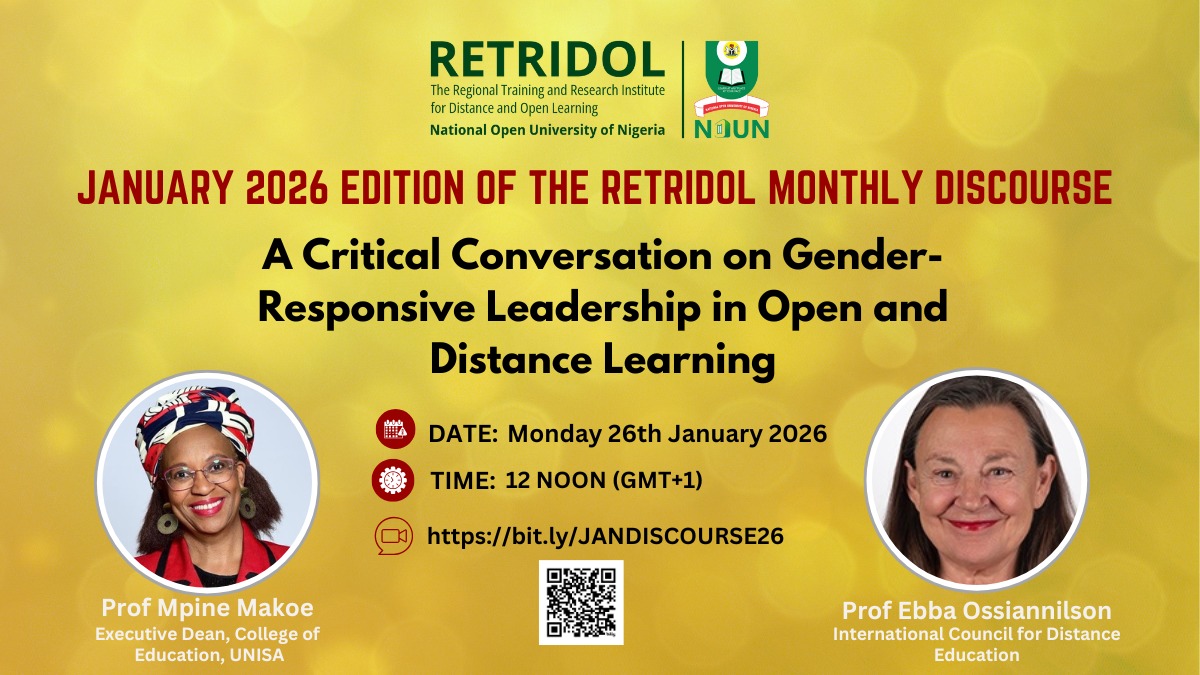
RETRIDOL A Critical Conversation on Gender-Responsive Leadership in Open and Distance Education (ODE)

RETRIDOL webinar on A Critical Conversation on Gender-Responsive Leadership in Open and Distance Education (ODE), will be held January 26, 2026

I am honored and humbled to have been invited to this very interesting and important panel discussion, together with my colleague Mpine Makoe. Thanks to Felix Kayode Olakulehin, Retridol. 

bcc84c01 5c06 4baf 8355 a7c8d1772040

Some of my arguments, which will be highlighted, are on

 From Gender-Neutral to Gender-Responsive Leadership
  • Gender-neutral leadership assumes equality; in practice, it often reinforces existing inequities.

  • Gender-responsive leadership explicitly acknowledges structural barriers, power relations, and lived realities.

  • Moves beyond numerical representation toward transformative and equity-driven leadership.

  • Requires an intersectional approach, addressing gender alongside age, disability, socio-economic status, geography, and culture.

  • Applies across policy, pedagogy, assessment, technology, and organizational culture.

  • Emphasizes ethical, relational, and care-centered leadership, particularly relevant in ODE contexts.

Panel question:
How can ODE leaders design for equitable outcomes rather than equal treatment?

Power, Governance, and Decision-Making

  • ODE systems often replicate traditional hierarchical power structures, despite an open ethos.

  • Women and marginalized groups remain underrepresented in strategic decision-making.

  • Key areas affected include digital transformation, AI adoption, funding priorities, and quality assurance.

  • Governance models may embed implicit gender bias through performance metrics and leadership norms.

  • Gender-responsive leadership requires transparent, participatory, and shared governance.

  • Invisible and care labor, disproportionately carried by women, must be recognized and valued.

Panel question:
Who holds decision-making power in ODE, and whose voices remain excluded?